Where LED display technology is heading: Mini-LED, Micro-LED, IoT, and sustainability
LED display technology trends: where Mini-LED, Micro-LED, IoT sensors, and recyclable modules are heading - and which move from R&D into production first.
The shift from SMD to COB for fine-pitch displays below P1.5 is now largely complete — we covered the reasoning behind that in our COB versus SMD explainer. The question the industry is now working through is what comes after COB, and which of the current development directions will reach production scale first.
Here is where things stand.
Mini-LED and Micro-LED
These are not the same technology, though they are often grouped together.
Mini-LED reduces chip size relative to standard LED (typically below 200 microns). The smaller chip allows higher pixel density on the same substrate, which pushes fine pitch further down while maintaining the production yields that make commercial-scale manufacturing feasible. Mini-LED is already in commercial production for backlit LCD panels; the challenge for direct-view LED is bringing the per-pixel cost down to a comparable level.
Micro-LED goes further — chips below about 50 microns, bonded using mass-transfer processes rather than individual pick-and-place. The potential is significant: higher peak brightness, near-infinite contrast (each pixel is independently driven with true off-state), and the ability to make transparent or flexible form factors that are not achievable with current COB. The manufacturing bottleneck is mass-transfer yield. At high-volume production rates, even a fraction of a percent transfer failure per chip adds up to visible defects on a panel with millions of pixels.
Smart displays and IoT integration
Displays are increasingly expected to adapt to their environment rather than run at a fixed setting. The practical version of this is ambient light sensing that adjusts brightness automatically — already common in high-end installations. The next step integrates audience-facing sensors: people-counting, dwell-time measurement, and content performance data fed back to the content management system.
For factory floor monitoring, logistics hubs, and traffic management applications, LED displays with sensor integration can show contextual data driven by live feeds rather than scheduled playlists. The hardware is largely available; the integration work is at the software and protocol level.
Energy efficiency and recyclable materials
Efficiency improvements at the chip level mean modern fine-pitch LED panels draw substantially less power per candela than panels from five years ago. This trajectory continues with Mini-LED and Micro-LED, partly because smaller chips have a more efficient thermal path and partly because the drive electronics scale down with the chip.
The recyclability direction is newer. Module design that uses fewer adhesives, more reversible fastening, and materials that can be separated at end of life is moving from a premium feature to a baseline expectation in European and North American markets, driven partly by procurement requirements at the enterprise and government level.
Flexible and conformable form factors
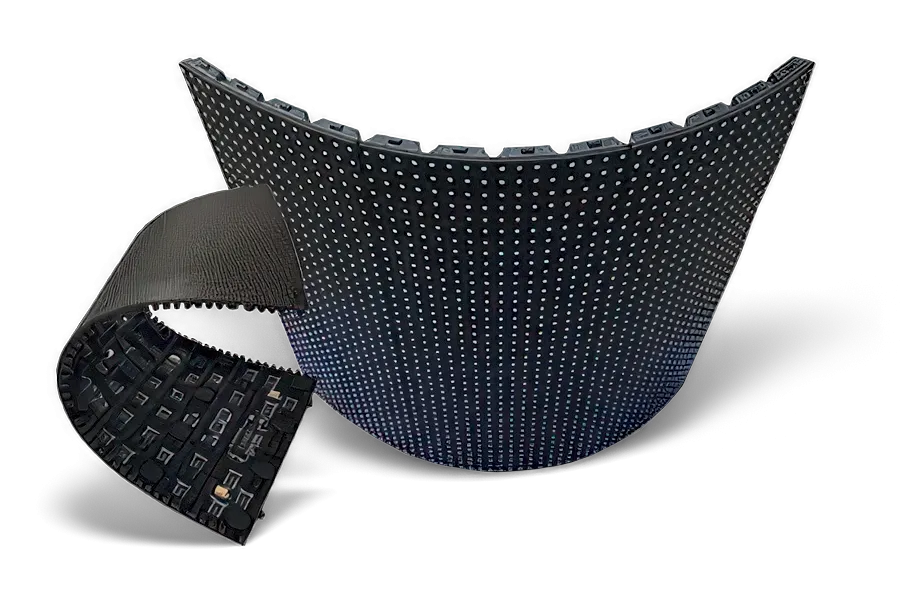
The architectural applications of flexible LED — covered in more detail on our flexible display product page — are expanding as the substrate materials improve. The near-term development is conformable displays: panels that can be shaped to a curved surface during installation and hold that shape permanently, rather than requiring a custom-bent frame. This opens installation options in architectural retrofits where a rigid frame cannot be fitted.
What this means in practice
Most of the above is at different stages of the pipeline: Mini-LED is production-ready today; Micro-LED at display scale is two to four years from commercial viability at current yield trajectories; IoT integration is an integration-layer question, not a hardware limitation. We track all of these actively and will publish updates as they move from development into our product line.
For enquiries about current product capabilities or lead-time on specific formats, contact us.
CONTINUE READING
More from the factory
-
P1.2 HD Wall now ships with 8K signal chain
The new P1.2 HD Wall ships with a full 8K signal chain — fibre-input controllers, on-board processing, frame-locked outputs. ARECH factory update.
Read article -
Why ARECH fine-pitch LED displays use COB, not SMD
COB vs SMD for fine-pitch LED displays: how a sealed epoxy surface beats SMD packaging on reliability, contrast, and heat - and why ARECH builds in COB.
Read article -
P0.9 and P1.25 fine-pitch LED video wall vs LCD
ARECH's P0.9 and P1.25 fine-pitch LED video walls hit 1.2 million pixels per square metre with CNC-machined cabinets that erase the bezel gaps of LCD walls.
Read article -
Flex COB LED display: COB image quality on a panel that bends
ARECH's Flex COB LED display brings COB's sealed epoxy surface to a bendable panel - about 40% lower power, 160 degree viewing angle, plus column and wave curves.
Read article -
New flexible P1.875 LED module: longer body, tighter bend
ARECH's flexible P1.875 LED module (ACIDPO1.875FF) uses a 270x120mm body to cut bending stress and improve flatness on curves. Samples in 30 days.
Read article -
Immersive LED display: 7,680Hz refresh, 270 degree wraps, full-dome formats
ARECH's immersive LED display line runs at 7,680Hz+ for XR and naked-eye 3D, with 270 degree wraps, curved walls, panoramic formats, and full-dome ceilings.
Read article