
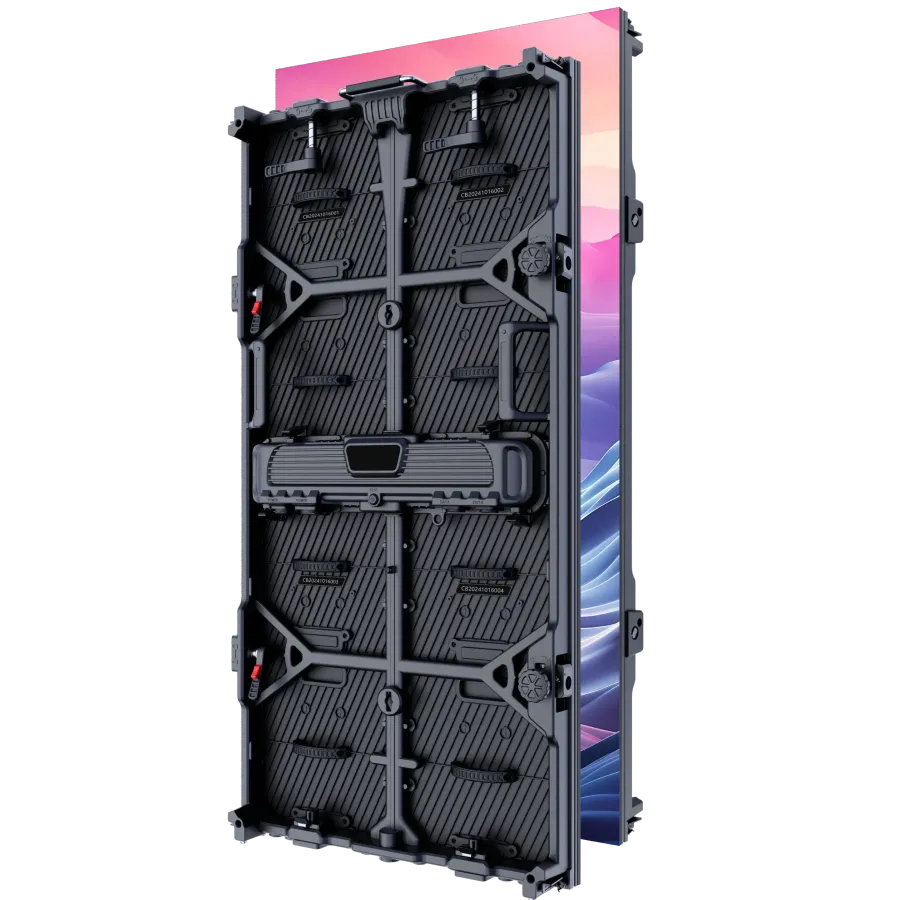
COB vs SMD LED: What the Packaging Type Actually Changes
SMD, COB, and GOB explained plainly: how each LED packaging type affects fine pitch, knock-resistance, viewing angle, moire, and whether it suits your install.
Most buyers compare LED screens by pixel pitch, brightness, and price. Far fewer ask how the chips are mounted. Yet that one manufacturing decision sets how fine a pitch you can reach, how well the screen survives a knock, and what the image looks like from an angle. Here is how SMD and COB differ, and which one your job calls for.
Two Ways to Mount an LED Chip
Every LED screen is built from the same basic component: a tiny semiconductor chip that emits light. What changes between SMD and COB is what happens to that chip before it lands on the circuit board.
SMD (Surface-Mounted Device) packages each chip into a small plastic housing, with its own miniature lens and reflector cup, then solders those packages onto the PCB one by one. The result is a module covered in a regular grid of discrete packages, each separated by a small gap.
COB (Chip-on-Board) skips the individual housing. Multiple chips are bonded directly onto the PCB substrate, then the whole cluster is covered in a single continuous layer of epoxy resin. There are no separate packages, no gaps between them, just a smooth surface.
That difference at the manufacturing stage is what drives every downstream trade-off: pitch capability, durability, surface reflectance, and viewing angle all follow from it.
Fine Pitch: How Tight the Pixels Can Sit
The individual plastic housings in SMD modules occupy physical space. As you push the pixel pitch tighter, those housings start to crowd each other, and at some point the mechanics stop working. COB removes that constraint. With chips bonded directly to the substrate, the pitch can go considerably tighter.
COB panels reach pitches from P0.7 to P1.9, so sub-millimetre pitch is achievable. The smallest SMD pitches start where COB comfortably sits. This is why broadcast studios, control rooms, and cinema-grade home theatre installs almost always specify COB when they need a fine-pitch wall: it is the only technology that gets you there without stacking compromises.
If your minimum viewing distance is under two metres and the content is dense, such as dashboards, maps, or live data, COB is the practical choice. See the HD wall range for what fine-pitch COB looks like in a spec sheet.
Durability and the Epoxy Surface
The continuous epoxy seal over a COB module does more than hold the chips in place. It gives the panel properties that discrete SMD packages cannot match.
- Impact resistance. The epoxy layer absorbs knocks that would chip or dislodge an individual SMD package. You can touch the surface without risking damage.
- Moisture and dust resistance. There are no microscopic gaps between packages for water or fine particles to enter. The surface can be wiped clean, and according to ARECH's own testing, sprayed with water without damage.
- Static protection. The encapsulation shields the chips from electrostatic discharge during handling and installation.
For SMD, each package is a separate point of vulnerability. Drop a flight case on a panel corner, and individual packages can pop. On a COB panel, the same impact is spread across the continuous seal.
This matters most in two situations: rental and touring installs, where panels are cased, stacked, and uncrated hundreds of times; and public-facing installs such as airports, hotel lobbies, and showrooms, where the screen may be touched or cleaned by people who are not AV technicians.
Viewing Angle and the Moire Question
SMD modules have gaps between each package. Those gaps act as tiny light traps: they absorb some of the light that should be reaching the viewer, which reduces uniformity and, at certain viewing angles, creates a slight grille effect. The finer the pitch on an SMD screen, the more pronounced this can be.
COB eliminates those gaps. The smooth lens-like surface distributes light more evenly across the viewing cone, which produces higher contrast and a more uniform image, most visible at wide off-axis angles.
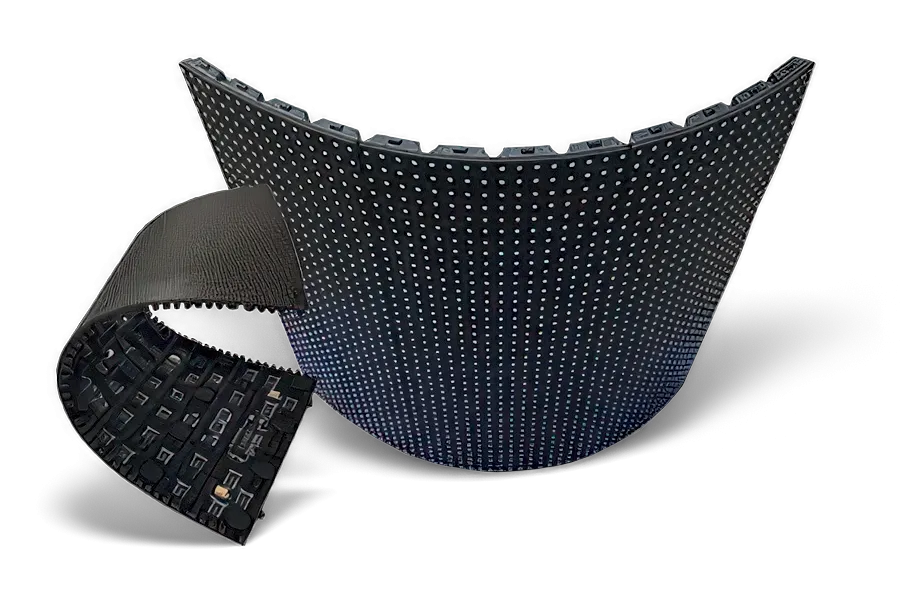
On rigid COB indoor panels, viewing angles reach up to 175°. On flexible COB panels, where the substrate bends to wrap columns, curves, or concave surfaces, the figure is up to 160°. That gap reflects the flex substrate rather than any weakness in the COB technology itself.
The moire risk also drops with COB. Moire shows up when the pixel grid interferes with a camera sensor grid or a fine-detail pattern in the content, and broadcast and XR productions deal with it constantly. The smoother, more uniform surface of a COB panel reduces the optical conditions that produce moire, which is one reason it has become the preferred choice for virtual production stages and broadcast backdrops.
Power Draw, and Where GOB Fits
COB panels draw less power than a comparable SMD panel. The efficiency difference comes from the shorter electrical path from chip to circuit board and the absence of the extra thermal mass from individual package housings. ARECH's rigid COB indoor screens draw roughly 30% less power than an equivalent SMD display. On flexible COB panels, which compare against the broader category of standard rigid displays, the measured difference is around 40%.
These two figures have different baselines and different products behind them, so do not treat them as interchangeable. Both are real, and the gap reflects what you are comparing against.
A note on GOB (Glue-on-Board). GOB is sometimes listed alongside COB as a third packaging type. In practice, GOB is an SMD module with a clear protective coating applied over the existing discrete packages. It adds knock-resistance to an SMD module without changing the chip-mounting approach. GOB improves durability over bare SMD, but it does not close the pitch gap with COB, and the coating can affect colour uniformity if it is applied unevenly. If your spec calls for sub-1.5mm pitch or the highest durability, COB is the cleaner answer.
Which Technology for Which Job
- Pitch below P2.0 — SMD: Difficult at fine end; COB: Yes, P0.7–P1.9 achievable
- Rental / touring (heavy casing) — SMD: Vulnerable packages; COB: Epoxy seal handles casing knocks
- Public-facing, touchable surface — SMD: Risk of package damage; COB: Wipe-clean, impact-resistant
- Broadcast / XR / moire-sensitive — SMD: Possible grille effect; COB: Preferred — uniform surface
- Wide angle viewing (>160°) — SMD: Degrades toward edges; COB: Up to 175° on rigid COB
- Budget-first, coarser pitch — SMD: Cost-effective; COB: Premium, fine pitch justified
For indoor fine-pitch installs such as control rooms, broadcast, conference, luxury hotel, and cinema, COB is the default recommendation. For flexible and curved applications, flexible COB panels handle column wraps, concave arches, and complex geometry while keeping the same epoxy-seal durability.
If you are working with a coarser pitch and the screen will not be handled heavily, SMD remains a practical choice and costs less per square metre. The decision is not categorical. It comes down to your pitch target, handling conditions, and viewing requirements.
Send us the venue brief and we will specify the right family. Contact the engineering team →
CONTINUE READING
More from the blog
-
How ARECH's LED Display Warranty Works: 2 or 3 Years, and What Decides It
How ARECH's LED Display Warranty Works: why the term is 2 or 3 years depending on the LED chip, what is excluded, and…
-
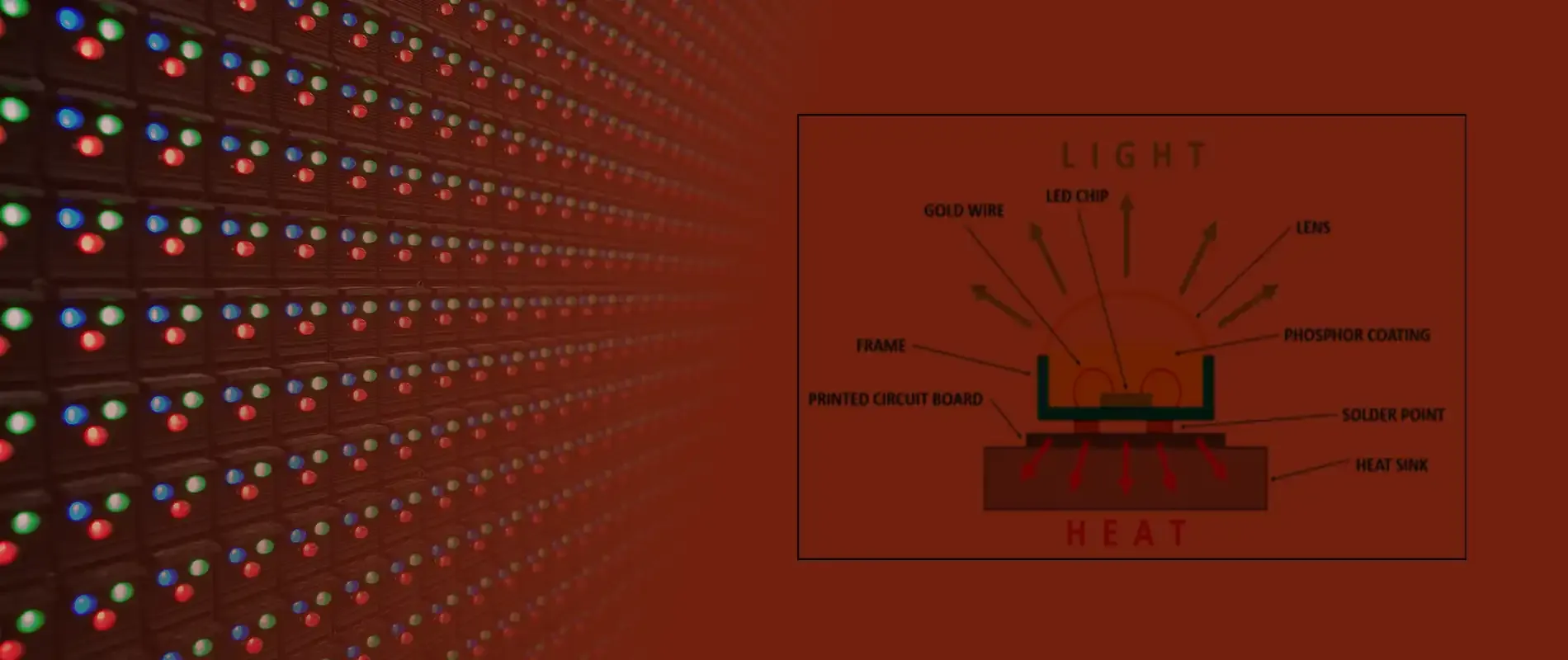
Inside the Ageing Chamber: Every Cabinet is tested
Inside the Ageing Chamber: Every ARECH LED cabinet runs an ageing-chamber burn-in cycle before pack-out.
-

Curved and Flexible LED: How It Bends and Where It Fits
Curved and Flexible LED: How bend into columns, domes, and sculptural shapes, why magnetic mounting makes them…
-

What ARECH's LED Display Certifications Mean: CE, FCC, RoHS, ISO 9001, LVD
What ARECH's LED Display Certifications Mean: CE, FCC, RoHS, and ISO 9001, LVD certification each cover on an LED…
-

Indoor vs Outdoor LED Displays: How to Choose the Right One
Indoor vs Outdoor LED Displays: differ in brightness, weatherproofing, pixel pitch, and cabinet build. Here is how to…
-

Pixel Pitch Explained: Matching an LED Display to Viewing Distance
Pixel Pitch Explained - What pixel pitch means, how it sets minimum viewing distance, and how to pick the right LED…