Creative Flexible LED: Curved, Circular and Sculptural Shapes That Hold Up
How flexible LED panels wrap columns, form spheres and domes, and how GOB/COB surface protection keeps soft modules durable in demanding installations.

Flat LED panels cannot wrap a column, close a sphere or follow a dome. Flexible LED modules do all three, and a GOB or COB surface keeps them working through installation, cleaning and years of use. This article shows how the geometry works, what the specs look like, and where the surface protection earns its place.
What a Soft Module Actually Is
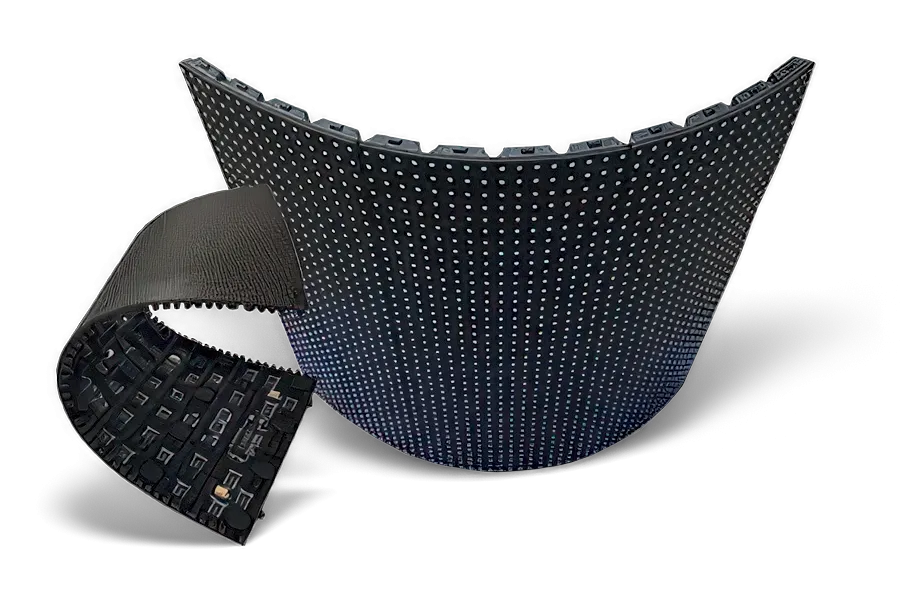
A flexible LED module is built on a soft rubber substrate combined with a PCB base. Unlike a rigid aluminium cabinet, the module bends in one or more axes without cracking the board or breaking the LED solder joints.
The pixel pitch range runs from P0.9 for close-up retail or immersive installations up to P5 for larger-scale architectural work. Common module sizes include 240×120 mm, 200×150 mm, 300×150 mm, 300×168.75 mm and 320×160 mm. These are the individual soft tiles you combine to cover a form, not a finished cabinet; flexible installs rarely use a rigid cabinet at all.
The bend tolerance is meaningful: ARECH's flexible series can form a complete circle as small as roughly 494 mm in diameter. That is tight enough to wrap a mid-sized column cleanly or to close a cylindrical display without a visible seam at the join.
Shapes Flexible LED Can Take
Flat, rectangular LED is still the default for broadcast and boardroom walls. Flexible LED opens a different set of forms.
- Cylinder and column wrap. Soft modules tile around a vertical column or a freestanding can-shaped structure. The image runs continuously around the circumference, with no break at the edge.
- Concave and convex curves. A concave curve pulls the viewer's attention inward; a convex curve pushes outward and reads from wider angles. Both are achievable without custom structural engineering, because the module follows the surface.
- Sphere and hemisphere. Full spherical displays, inner and outer, are built from multiple soft-module strips that converge at the poles. Hemispherical and dome configurations use the same approach with a flat floor or ceiling mount.
- Ribbon and wave. Long, narrow flexible runs can sweep across a façade or ceiling in flowing curves, carrying a continuous video band.
- Arched openings. Doorways and portals can carry a live video frame around the arch rather than just above it.
Aspect ratios are not fixed to 16:9. The modules support 21:9 and fully custom ratios, which matters when the structure dictates the canvas rather than the other way around.
For a closer look at how the bend mechanics and mounting hardware work day-to-day, see the companion article on flexible LED screen mounting and installation. This piece covers the creative geometry and the surface protection side.
Why the Surface Coating Matters as Much as the Bend
Soft modules introduce a practical problem rigid cabinets avoid: the LED packages sit closer to the surface and have less mechanical backing to protect them. During shipping, installation and especially cleaning, the exposed pixels are vulnerable to physical contact.
GOB (glue-on-board) addresses this directly. A transparent epoxy compound is poured over the LED surface after mounting, filling the gaps between pixels and forming a hard, optically clear protective layer. The epoxy shields the pixels from contact during handling, resists moisture and keeps dust from accumulating in the gaps.
COB (chip-on-board) takes a different route to a similar result: the LED chip is mounted directly on the board without individual lead frames, then covered as a unified surface. The result is a flat, smooth face with no exposed wire bonds.
For outdoor flexible applications, the protective layer combines with an IP65 rating and over 6,000 nits of brightness, enough output to stay readable in full daylight. These figures apply to the outdoor flexible series; indoor flexible modules have different brightness and IP specifications appropriate to controlled environments.
Where Creative Flexible LED Gets Specified
The form-factor flexibility expands what is possible in environments that standard rigid panels cannot serve:
- Corporate lobbies and brand experiences. A wrapped column or curved ribbon wall carries a brand presence that a flat screen simply cannot reproduce in the same space.
- Exhibition booths and flagship retail. Hemispherical ceiling installs or concave walls draw visitors into the display rather than presenting it at them.
- Command and control centres. Concave curved walls reduce peripheral distraction and keep a large display within a tighter viewing cone, which is why they are common in surveillance, logistics and emergency response rooms.
- Immersive and experiential installations. Spheres, domes and fully custom sculpted shapes for venues where the display is the architecture, not an object placed against it.
The flexible LED product page covers the full family including module options, pitch choices and datasheet downloads. For projects that sit at the boundary between creative flexible and a high-resolution flat format, the HD wall range is the comparison to make.
Specifying a Creative Flexible Installation
The variables that change most on a non-flat installation are the surface geometry and the minimum radius.
Start with the surface. Is it single-axis (a cylinder) or double-axis (a sphere)? Single-axis bends are straightforward: the module tiles in one direction and the seaming follows the curve. Double-axis requires careful planning of module orientation and panel layout to avoid visible distortion at the joins.
Then the pixel pitch. If viewers stand within two to three metres of the surface, P0.9 to P2 keeps the image sharp. For larger sculptural installs where the closest viewer is further back, a P3 to P5 pitch keeps cost and weight in check.
Finally, the surface protection choice (GOB vs COB) is worth discussing early. Both work; the difference is optical texture and cost. ARECH's engineering team can walk through the trade-off once the form and environment are defined.
CONTINUE READING
More from the blog
-
How ARECH's LED Display Warranty Works: 2 or 3 Years, and What Decides It
How ARECH's LED Display Warranty Works: why the term is 2 or 3 years depending on the LED chip, what is excluded, and…
-
Inside the Ageing Chamber: Every Cabinet is tested
Inside the Ageing Chamber: Every ARECH LED cabinet runs an ageing-chamber burn-in cycle before pack-out.
-

Curved and Flexible LED: How It Bends and Where It Fits
Curved and Flexible LED: How bend into columns, domes, and sculptural shapes, why magnetic mounting makes them…
-

What ARECH's LED Display Certifications Mean: CE, FCC, RoHS, ISO 9001, LVD
What ARECH's LED Display Certifications Mean: CE, FCC, RoHS, and ISO 9001, LVD certification each cover on an LED…
-

Indoor vs Outdoor LED Displays: How to Choose the Right One
Indoor vs Outdoor LED Displays: differ in brightness, weatherproofing, pixel pitch, and cabinet build. Here is how to…
-

Pixel Pitch Explained: Matching an LED Display to Viewing Distance
Pixel Pitch Explained - What pixel pitch means, how it sets minimum viewing distance, and how to pick the right LED…